




Your shopping cart is currently empty.
Fire Extinguishers
 Fire extinguishers are available in different types, capacities
and fire ratings for specific workplace hazards. Select Safety Sales supplies
portable and wheeled fire extinguishers for commercial, industrial,
institutional, government, fleet and facility applications.
Fire extinguishers are available in different types, capacities
and fire ratings for specific workplace hazards. Select Safety Sales supplies
portable and wheeled fire extinguishers for commercial, industrial,
institutional, government, fleet and facility applications.
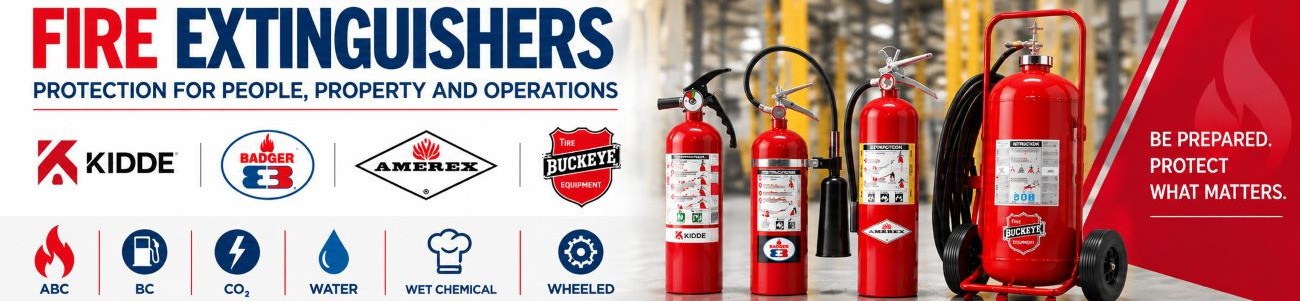
Shop ABC, BC, carbon dioxide (CO2), water, wet chemical and wheeled fire extinguishers from leading manufacturers including Kidde, Badger, Amerex and Buckeye.
Need fire extinguishers in quantity? We can supply larger commercial orders and pallet quantities for facilities, contractors, government agencies and multi-location organizations. Contact us for quantity pricing and availability.
Choose a fire extinguisher category below to compare extinguisher types, capacities and fire ratings for your application.
Fire Extinguishers for Commercial & Industrial Applications
Selecting the right fire extinguisher starts with identifying the types of fire hazards present in the area being protected. Extinguishers are available with different extinguishing agents, capacities and fire ratings for applications ranging from offices and commercial buildings to warehouses, manufacturing facilities, commercial kitchens, vehicles and higher-hazard industrial locations.
Select Safety Sales offers portable and wheeled fire extinguishers from leading manufacturers including Kidde, Badger, Amerex and Buckeye. Our selection includes multipurpose ABC dry chemical extinguishers, BC extinguishers, carbon dioxide (CO2) extinguishers, water and wet chemical models, and larger-capacity wheeled extinguishers.
Types of Fire Extinguishers
Different extinguishing agents are designed for different fire hazards. The appropriate extinguisher should be selected according to the hazards present, required fire rating, facility conditions and applicable fire-protection requirements.
| Extinguisher Type | Common Fire Hazards | Typical Applications |
|---|---|---|
| ABC Dry Chemical | Class A ordinary combustibles, Class B flammable liquids and Class C energized electrical equipment | Offices, warehouses, manufacturing, construction, commercial facilities and general workplace protection |
| BC Dry Chemical | Class B flammable liquids and Class C energized electrical equipment | Vehicles, garages, mechanical areas, fuel-related hazards and selected industrial applications |
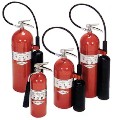
| Carbon Dioxide (CO2) | Class B flammable-liquid hazards and Class C energized electrical equipment | Electrical equipment, laboratories and locations where a clean, residue-free agent is desirable |
| Water | Class A ordinary combustible materials | Locations with primarily wood, paper, cloth and similar Class A hazards |
| Wet Chemical | Class K commercial cooking hazards and applicable Class A hazards depending on model rating | Commercial kitchens, restaurants, cafeterias and institutional cooking facilities |
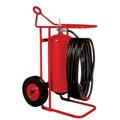
| Wheeled Extinguishers | Varies by extinguishing agent and model | Industrial and higher-hazard applications requiring greater agent capacity and extended discharge capability |
Important: No single extinguisher is appropriate for every fire
hazard. Select extinguishers according to the anticipated classes of fire and the
size and degree of the hazard in the protected area.
Understanding Fire Classes
Fire extinguishers are identified by the classes of fire for which they are designed. Understanding these classifications helps determine which extinguisher is appropriate for a particular location.
| Fire Class | Type of Hazard | Common Examples |
|---|---|---|
| Class A | Ordinary combustible materials | Wood, paper, cloth and many plastics |
| Class B | Flammable liquids | Gasoline, oils, solvents and many paints |
| Class C | Fires involving energized electrical equipment | Electrical panels, motors, wiring and energized equipment |
| Class D | Combustible metals | Specific combustible-metal hazards requiring specialized extinguishing agents |
| Class K | Commercial cooking oils and fats | Deep fryers and other commercial cooking equipment |
How to Choose a Fire Extinguisher
Extinguisher selection should be based on the hazards present rather than simply choosing the largest extinguisher available. Consider the fire class, UL rating, capacity, extinguisher weight, discharge characteristics and where the extinguisher will be installed.
1. Identify the Fire Hazard
Determine what materials or equipment could potentially burn in the area. A warehouse containing ordinary combustibles may have different requirements than a commercial kitchen, vehicle maintenance area or electrical equipment room.
2. Check the Fire Rating
Fire extinguisher ratings provide more useful information than capacity alone. Two extinguishers containing a similar amount of agent may carry different fire ratings. Compare the complete rating when evaluating extinguishers for a specific application.
3. Consider Capacity and Handling
Larger extinguishers generally provide more extinguishing agent, but they are also heavier to carry and operate. Common portable dry chemical capacities include approximately 2.5, 5, 10 and 20 pounds. The appropriate capacity depends on the hazard, required rating, placement and intended users.
4. Consider the Installation Location
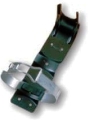
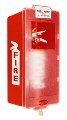
Fire extinguishers must remain visible or properly identified, readily accessible and protected from conditions that could damage the equipment. The mounting method may include a wall hook, bracket or extinguisher cabinet depending on the model and installation.
Portable vs. Wheeled Fire Extinguishers
Portable extinguishers are appropriate for a wide range of commercial and industrial applications. Larger industrial hazards may require greater extinguishing-agent capacity than is practical in a hand-carried extinguisher.
| Feature | Portable Fire Extinguishers | Wheeled Fire Extinguishers |
|---|---|---|
| Mobility | Carried directly by the operator | Moved on a wheeled carriage |
| Agent Capacity | Designed for hand-portable operation | Substantially greater capacity available |
| Typical Use | Commercial, institutional, fleet and general industrial protection | Industrial and higher-hazard applications |
| Discharge | Nozzle or hose depending on extinguisher design | Typically incorporates a longer hose for greater working reach |
| Extinguishing Agent | Varies by extinguisher type | Varies by model and hazard being protected |
Fire Extinguishers from Leading Manufacturers
Select Safety Sales supplies fire extinguishers from established fire-protection manufacturers including Kidde, Badger, Amerex and Buckeye. Available models range from compact portable extinguishers to commercial and industrial units and large-capacity wheeled equipment.
When comparing manufacturers, consider the individual model's fire rating, agent capacity, construction, discharge performance, mounting equipment and intended application rather than selecting by brand name alone.
Bulk & Pallet Fire Extinguisher Orders
Purchasing fire extinguishers for an entire facility, project or multiple locations? Select Safety Sales can supply larger quantities of commercial and industrial fire extinguishers, including case and pallet quantities of many popular models.
We work with businesses, contractors, industrial facilities, government agencies, educational institutions, healthcare organizations and other buyers that may require multiple extinguishers or large-volume orders.
For bulk requirements, call 866-864-3495 for quantity pricing, product availability and shipping options.
Fire Extinguisher Inspection & Maintenance
Workplace fire extinguishers should be maintained in operable condition and remain in their designated locations except when being used or serviced. For workplaces covered by OSHA's portable fire extinguisher requirements, portable extinguishers must be visually inspected monthly and receive an annual maintenance check.
Routine visual inspection should include checking that the extinguisher:
- Is in its designated location and readily accessible.
- Is clearly visible or properly identified.
- Has not been physically damaged or subjected to corrosion or leakage.
- Has an intact pull pin and tamper seal when applicable.
- Shows the proper pressure indication when equipped with a gauge.
- Has a hose or nozzle that is unobstructed and in good condition.
- Has legible operating instructions.
Maintenance, recharging and hydrostatic testing should be performed at the required intervals by appropriately qualified personnel using the manufacturer's instructions and applicable requirements.
Frequently Asked Questions About Fire Extinguishers
What is the most common type of fire extinguisher?
Multipurpose ABC dry chemical extinguishers are commonly used for general commercial and workplace protection because they are rated for Class A, Class B and Class C hazards. The correct extinguisher still depends on the specific hazards present.
What size fire extinguisher do I need?
The appropriate extinguisher depends on the anticipated fire hazard, required fire rating, hazard severity, placement and applicable requirements. Capacity alone should not be used to determine which extinguisher is appropriate.
What is the difference between ABC and BC fire extinguishers?
ABC extinguishers are rated for Class A ordinary combustibles in addition to Class B flammable liquids and Class C energized electrical equipment. BC extinguishers do not carry the Class A rating and are intended for applicable Class B and Class C hazards.
When should I use a CO2 fire extinguisher?
Carbon dioxide extinguishers are rated for applicable Class B and Class C hazards and leave no dry chemical residue after discharge. This can make them useful around certain electrical or sensitive equipment where residue is undesirable, provided the extinguisher is appropriate for the actual hazard.
What type of extinguisher is used in a commercial kitchen?
Commercial cooking operations involving high-temperature cooking oils and fats typically require Class K wet chemical protection. The required equipment should be selected according to the cooking hazards, applicable codes and fire-protection requirements.
When should I consider a wheeled fire extinguisher?
Wheeled extinguishers are generally used for industrial and higher-hazard applications where substantially greater agent capacity and extended hose reach are beneficial. The appropriate agent and fire rating depend on the specific hazard being protected.
How often should workplace fire extinguishers be inspected?
For workplaces subject to OSHA 29 CFR 1910.157, portable fire extinguishers must be visually inspected monthly and receive an annual maintenance check. Additional maintenance and hydrostatic testing requirements depend on extinguisher construction and type.
Can I order fire extinguishers by the pallet?
Yes. Select Safety Sales can supply larger commercial orders and pallet quantities of many fire extinguisher models, subject to manufacturer availability. Contact us for quantity pricing, availability and shipping options.
Need Help Selecting Fire Extinguishers?
Choosing between different extinguisher types, capacities and fire ratings can be difficult when several models appear similar.
Select Safety Sales can help commercial, industrial, institutional and government buyers compare fire extinguishers based on the application, fire hazard, capacity and product specifications.
Call Select Safety Sales at 866-864-3495 for product assistance, quantity pricing or pallet-quantity requirements.
