


Your shopping cart is currently empty.
How to Use an Eyewash Station
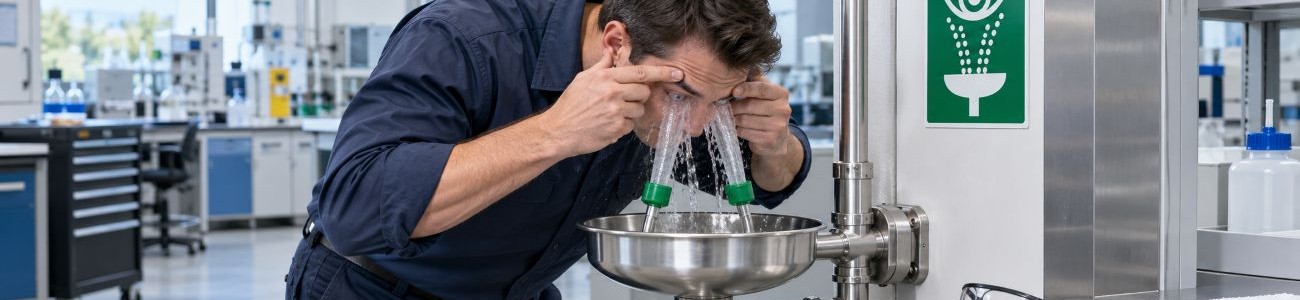
Act Immediately After an Eye Exposure
If a chemical, hazardous substance or irritating material enters the eyes, begin flushing immediately. Do not delay irrigation while searching for a supervisor, reading the Safety Data Sheet or removing contact lenses. Activate the closest appropriate eyewash station and follow the facility's emergency response procedure.
The steps below provide general workplace guidance. The Safety Data Sheet, employer procedures, emergency medical personnel and the specific substance involved may require additional or longer treatment.
Emergency priority: Begin flushing first. A coworker can retrieve the Safety Data Sheet and contact medical assistance after irrigation has started.
Steps for Using an Emergency Eyewash Station
- Go directly to the eyewash station. Move immediately to the nearest appropriate unit. A coworker should guide the exposed person when vision is impaired.
- Activate the eyewash. Push or pull the activation handle in one motion. A properly operating unit should remain on without the user holding the valve.
- Position both eyes in the flushing streams. Lower or position the face so the flushing fluid reaches both eyes. Avoid forcing the eyes against a high-pressure stream.
- Hold the eyelids open. Use clean fingers to keep the upper and lower eyelids apart so flushing fluid reaches the eye surfaces and beneath the lids.
- Roll the eyes gently. Look up, down and from side to side while flushing to help the fluid reach the entire eye area.
- Remove contact lenses during flushing. Begin irrigation first. Remove contact lenses as soon as practical while flushing; never postpone irrigation to remove them.
- Continue flushing. Flush continuously for at least 15 minutes unless the Safety Data Sheet, emergency procedure or medical personnel directs a longer period. Do not stop early because discomfort begins to improve.
- Obtain medical assistance. Arrange prompt evaluation according to the facility's emergency plan and the substance involved. Continue irrigation during transport when directed and practical.
Important Actions to Avoid
- Do not rub the eyes.
- Do not delay flushing to complete paperwork, report the incident or locate the Safety Data Sheet.
- Do not use neutralizing chemicals, ointments or eye drops unless directed by qualified medical personnel or specific emergency instructions.
- Do not aim a forceful stream directly at the eyes.
- Do not allow the exposed person to walk unassisted if vision is impaired.
- Do not assume that 15 minutes is adequate for every substance; follow chemical-specific instructions and medical direction.
What a Coworker or Supervisor Should Do
- Guide the exposed worker to the eyewash immediately.
- Activate the unit if the worker cannot do so.
- Help keep the worker positioned in the flushing streams without restricting safe movement.
- Contact emergency medical services, the facility response team or Poison Control as required by the emergency plan.
- Retrieve the Safety Data Sheet and product information after flushing has begun.
- Provide the chemical identity and exposure details to medical personnel.
- Secure the incident area and report equipment problems without interrupting care.
Contact Lenses and Eye Protection
Contact lenses are not eye protection. Workers must use the eye and face protection required by the hazard assessment. Following an exposure, irrigation should begin immediately and contact lenses should be removed as soon as practical while flushing continues.
Employee Training Before an Emergency
Employees should not be learning how to use an eyewash for the first time during an exposure. Training should include the location of every applicable unit, the unobstructed route from the work area, activation method, correct flushing position, contact-lens procedure, alarm or communication steps and how to summon medical assistance.
Routine drills can help identify blocked routes, poor signage, inadequate lighting and employees who do not know which equipment serves their work area.
After the Incident
- Follow medical advice and the facility's exposure-response procedure.
- Document the substance, exposure circumstances, flushing start time and approximate duration.
- Remove affected equipment from service if it did not operate correctly.
- Inspect, clean and return the eyewash to service according to the manufacturer's instructions.
- Replace portable flushing fluid or sealed cartridges after use as required by the manufacturer.
- Review the incident to determine whether changes to PPE, procedures, training or equipment placement are needed.
Frequently Asked Questions
Should Contact Lenses Be Removed Before Flushing?
No. Start flushing immediately. Remove contact lenses as soon as practical while irrigation continues.
How Long Should the Eyes Be Flushed?
Emergency eyewash equipment is designed to provide at least 15 minutes of flushing. Some substances require longer irrigation, so follow the Safety Data Sheet, workplace procedures and medical direction.
Should an Injured Worker Use Eye Drops After Flushing?
Do not place eye drops, ointments or neutralizing solutions in the eyes unless instructed by qualified medical personnel or specific emergency guidance.
Is Medical Evaluation Necessary After Flushing?
Chemical eye exposures can cause serious injury even when symptoms improve. Follow the Safety Data Sheet and facility emergency plan and obtain prompt medical guidance appropriate to the substance and exposure.
Prepare before an exposure occurs. Shop Eyewash Stations, eyewash replacement parts and eyewash preservative, or call Select Safety Sales at 866-864-3495 for product assistance.
