





Your shopping cart is currently empty.
How to Choose an Eyewash Station for Your Facility
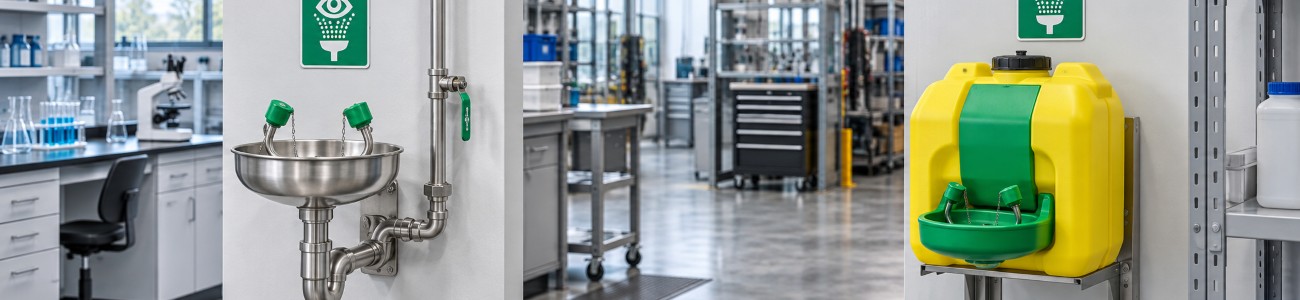
Selecting Emergency Eyewash Equipment
Choosing an emergency eyewash station begins with the workplace hazard, not the equipment style or price. The proper solution depends on what could contact the worker, whether the eyes or body may be exposed, where the incident could occur, the available water supply and the environmental conditions at the installation site.
Use this guide to narrow the available equipment, then confirm the selection against the facility's hazard assessment, current OSHA requirements, ANSI ISEA Z358.1 and the manufacturer's specifications.
Start With the Hazard Assessment
- Identify corrosive chemicals, irritants, dusts and other materials that could contact the eyes, face or body.
- Review the Safety Data Sheet for every relevant substance, especially the hazard identification and first-aid sections.
- Determine whether the likely exposure is limited to the eyes or could affect the face and body.
- Identify each location where exposure could occur and the number of workers potentially affected.
- Evaluate the path, lighting, floor level, temperature and available plumbing at each location.
Compare the Main Types of Eyewash Equipment
| Equipment Type | Best Suited For | Important Considerations |
|---|---|---|
| Plumbed eyewash | Permanent hazard locations with a dependable water supply | Requires plumbing, drainage planning, tepid fluid and weekly activation. |
| Portable self-contained eyewash | Remote, temporary or fixed areas without suitable plumbing | Check capacity, service interval, mounting, fluid type and manufacturer instructions. |
| Wall-mounted eyewash | Permanent installations where floor space is limited | Requires suitable wall support, plumbing and proper nozzle height and clearance. |
| Pedestal eyewash | Open work areas or locations where wall mounting is impractical | Requires floor placement, plumbing and protection from impact or obstruction. |
| Eye and face wash | Hazards that may affect the eyes and surrounding facial area | Provides broader coverage and requires the applicable higher flow rate. |
| Heated or freeze-protected eyewash | Outdoor, unheated or freezing environments | Verify temperature range, power needs, freeze protection and alarms if applicable. |
| Combination eyewash and shower | Potential exposure to both eyes and body | Both components must perform properly when operated at the same time. |
Portable or Plumbed Eyewash
Choose a Plumbed Eyewash When
- The hazard location is permanent.
- A dependable water supply can be provided at the required location.
- The facility can manage installation, drainage and weekly activation.
- Continuous flushing and frequent readiness checks are operationally practical.
Choose a Portable or Self-Contained Eyewash When
- Plumbing is unavailable or impractical at the hazard location.
- The work area is temporary, remote or may be relocated.
- A compliant primary self-contained unit can be positioned within the required access time.
- The facility can follow the specified fluid, cleaning, cartridge and inspection schedule.
Important: Portable does not automatically mean supplemental. Some self-contained stations are designed as primary emergency eyewashes, while squeeze bottles are supplemental. Confirm the manufacturer's stated compliance and operating duration before purchasing.
Consider the Type and Extent of Exposure
A conventional eyewash is intended primarily for the eyes. If the hazard could splash onto the eyes and surrounding facial area, consider an eye and face wash. If a worker's body or clothing may also be exposed, evaluate an emergency shower or combination eyewash and shower in the separate Safety Showers category.
Check the Installation Environment
Plan for Tepid Flushing Fluid
The flushing fluid must remain within the applicable tepid range. A plumbed installation may require a thermostatic mixing valve. Outdoor or unheated areas may require heated or freeze-protected equipment. For portable equipment, room temperature alone should not be assumed to guarantee compliant fluid temperature; evaluate the actual fluid temperature under expected site conditions.
Measure Before Ordering
- Confirm wall, counter or floor space and required operating clearances.
- Check the filled weight of self-contained equipment and provide structural support suitable for the unit and mounting method.
- Verify inlet, waste and drain connections for plumbed equipment.
- Confirm electrical voltage and certification requirements for heated units, alarms and accessories.
- Check whether the activation handle, bowl orientation or counter-mounted design is left-hand, right-hand or reversible.
Compare Ongoing Maintenance
Purchase price is only one part of the decision. Plumbed stations require weekly activation and periodic service. Refillable self-contained units require cleaning, preservative and fluid replacement according to the manufacturer. Sealed-cartridge units may reduce routine fluid handling but require replacement cartridges after use or at the specified expiration date. Compare labor, replacement supplies and downtime over the expected life of the equipment.
Eyewash Selection Checklist
- Identify the hazard. Review the process and Safety Data Sheets.
- Determine the required coverage. Eyes only, eyes and face, or eyes and body.
- Map the location. Confirm rapid access on the same level by an unobstructed path.
- Verify utilities. Check water, drainage, hot-water capacity and electrical service.
- Control the temperature. Plan how the flushing fluid will remain tepid.
- Confirm performance. Review the manufacturer's stated ANSI ISEA conformance and technical data.
- Plan maintenance. Assign inspections, activation, fluid service and recordkeeping.
- Train employees. Make sure workers can locate and operate the equipment immediately.
Frequently Asked Questions
Is a Portable Eyewash Less Compliant Than a Plumbed Unit?
Not necessarily. A properly selected self-contained unit may serve as primary emergency eyewash equipment when it meets the applicable requirements and is suitable for the hazard. Verify the manufacturer's specifications, capacity, flow duration and maintenance instructions.
Do I Need an Eyewash or an Eye and Face Wash?
That depends on the potential exposure. Choose equipment based on the hazard assessment and the area of the worker that may be affected, not simply the available space.
Do I Need a Thermostatic Mixing Valve?
A mixing valve may be needed when the incoming water supply cannot consistently provide tepid flushing fluid. Verify the valve capacity, inlet conditions and compatibility with the emergency fixture.
Can an Eyewash Bottle Serve as the Only Eyewash?
Eyewash bottles and personal wash units are supplemental and should not replace required primary emergency eyewash equipment.
Need help comparing eyewash equipment? Shop Eyewash Stations, including portable eyewash stations and plumbed eyewash equipment, or call Select Safety Sales at 866-864-3495 for product-selection assistance.
Important: This information is provided for general educational purposes and is not a substitute for a workplace hazard assessment, the current ANSI/ISEA Z358.1 standard, applicable OSHA requirements, Safety Data Sheet instructions, manufacturer instructions or qualified medical advice.
Before selecting equipment, review the facility’s hazard assessment, applicable OSHA requirements, the current ANSI/ISEA Z358.1 standard and the manufacturer’s specifications. See our Emergency Eyewash Station Requirements guide for additional information.
