





Your shopping cart is currently empty.
Fire Extinguishers - Classes, Types and Use

If you need to purchase a fire extinguisher, you may have questions about the different types that are available. Select Safety Sales has compiled this FAQ Sheet to help you make the correct choice when making your purchase. When should a person attempt to put a fire out with a fire extinguisher?
You should ONLY attempt to put out a fire in the early stages when it is small and contained and ONLY when there is a means of escape behind you that is clear of fire. If the fire has spread beyond the early stages, it is time to evacuate the building. Be sure that the fire extinguisher is large enough to put out the fire because many portable types will discharge completely within a matter of seconds. It is important to know the capabilities of the units that you have in your facility before a fire starts. It is better to have a larger fire extinguisher for the area rather than one that is too small.
What type of extinguisher should I purchase?
There are different types to choose from because there are different types of fires. This FAQ sheet will provide information regarding extinguishers available to fight various fires. Some can only be used on certain types of fires. It could be dangerous to use the wrong one.
How can I be sure that the one that I choose is approved for the type of fire that I need to extinguish?
They should be (UL) Underwriters Laboratory approved. Underwriters laboratory is a nationally recognized testing laboratory that verifies compliance with applicable standards (29.CFR 1910.157(c)(2). The extinguishers that pass the tests are given an alpha numeric classification based on the type and size of the fire it will extinguish; ie. 3A:40B:C
What do the letters mean in the alpha numeric classification?
The letter represents the type of fire that can be put out with a particular extinguisher. Fires are given the following classifications:
- (A) ordinary combustibles
- (B) flammable liquids
- (C) electrical equipment
- (D) metals
- (K) combustible cooking fluids such as oils and fats.
What do the numbers in the alpha numeric classification mean (ie. 1A:10B:C)?
There is a number rating for fire extinguishers classified for use on type A or B Fires. For Type A fires, a 1 would have the equivalent of 1¼ gallons of water, a 2 would be equivalent to 2½ gallons, 3 would be 3¾ gallons of water, and so forth. For Type B and Type C fires, the number represents the square footage that the extinguishing agent would cover. For example, a number 2 would cover two square feet and a 5 would extinguish an area five square feet and so forth. Extinguishers that fight electrical fires are labeled with a C, but not a number. This is because Class C fires are either Class A or Class B fires with electricity included in the mix. The C on the label indicates that the agent in the extinguisher is non-conductive.
Why do some fire extinguishers have more than one letter and number?
The reason that they have more that one letter and number is because they can be made to put out more than one type of fire. If the label reads 2A:5B, then it would work on Type A fires with a 2½ gallon equivalence and for Type B fires with 5 square feet equivalency.
Where can I find these classifications?
These classifications are right on the side of the extinguisher. You will also see labels for each type of fire that it can be used for.
Who makes the determination of how many extinguishers are needed in commercial buildings and the workplace?
Building codes (for buildings) and OSHA Standards (for the workplace) include the requirements of when and where they are required in building structures. The National Fire Protection Association (NFPA) writes the standard for selection, use and maintenance.
Do they require any type of maintenance once they are purchased?
Fire Extinguishers should be inspected monthly to insure that they are in good working order. This is essential to ensure that they will operate effectively if needed. The pressure gauge should be checked to make sure that the unit is fully charged. The needle on the gauge should be in the green zone. Also, the pin and tamper seal should be checked (located at the top of the unit) to make sure that they are intact. Each unit should be individually inspected to make sure they are in good physical condition. Annual inspections require testing to be sure that the units are fully pressurized, free from damage, and pull tests done on the pin and seal of rechargeable extinguishers. Seals or tamper indicators on non-rechargeable extinguishers must be left in place. The inspection tag should be dated after each inspection.
Who should perform the inspections of the extinguishers?
Inspection can be performed by in-house personnel without certification, but persons performing maintenance and re-charging should be certified. Training and certification by an organization recognized by the local authority having jurisdiction is required.
Do they require any special storage space?
They should be mounted on brackets or in wall cabinets. The carrying handle should be placed three and one half feet to five feet above the floor. Larger units should be mounted at a lower height and the carrying handle should be approximately three feet from the floor. They should be placed in highly visible, clearly labeled locations. Strap-type brackets should be used to secure fire extinguishers in vehicles or in any area where they can become dislodged.
Is special training required for workplaces that have fire extinguishers available for employees use?
OSHA standards require any workplace that has fire extinguishers available for their employees use to provide an educational program so that employees are able to familiarize themselves with Fire Extinguisher basics.
What is the Fire Triangle and how does it relate to fire extinguishers?
The Fire Triangle has three components: Oxygen, Heat and Fuel. These are the three necessary ingredients for a fire. If one or more of these components are removed, a fire can be prevented or extinguished. The goal of the fire extinguisher is to eliminate one or more of these components.
How do I use a fire extinguisher to put out a fire?
There is a simple pneumonic to remember when using one.
P ull the pin at the top of the extinguisher and this will release the lock.
A im the nozzle at the back of the fire
S queeze the handle
S weep the extinguisher from side to side (back and forth)
S weep the extinguisher from side to side (back and forth)
Fire Extinguishers For Class A Fires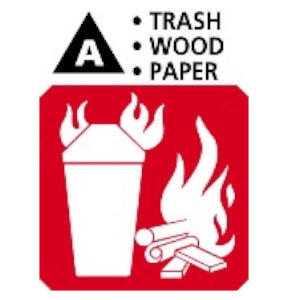
What type of materials would be burning for a fire to be classified as a Class A fire?
Paper
Cloth
Wood ORDINARY COMBUSTIBLES
Rubber
Plastics
What type is labeled for Class A fires?
The Air Pressurized Water (APW) is labeled a Class A extinguisher. It contains water which is one of the most commonly used extinguishing agents for fires involving ordinary combustibles.
What does this type look like?
They can be recognized by their large silver container. They stand about three feet in height and weigh about 25 lbs. when full.
What are the components in an APW fire extinguisher?
Two thirds of the container is filled with water and the remainder is pressurized air.
How is a fire extinguished with this type?
Fire is extinguished by cooling the surface of the fuel to remove the HEAT element of the fire.
Are there any recommendations for the placement of these units in a workplace or public area?
The National Fire Protection Agency (NFPA) does recommend that offices, classrooms and assembly halls that mainly contain Type A combustible materials have one 2:A extinguisher for every three thousand square feet. For workers protection in the workplace, OSHA requires that all employees have access to a one within seventy five feet of travel distance.
What type of fires should never be extinguished with an Air Pressurized Water (APW) fire extinguisher?
Flammable liquid fires and electrical fires should never be extinguished with an air pressured water extinguisher. A flammable liquid fire could spread and an electrocution could occur if water is used to extinguish an electrical fire. Also, never use this type on a deep fat fryer fire in a commercial kitchen. An explosive type reaction could result.
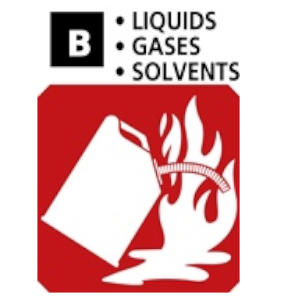
Fire Extinguishers For Class B Fires
What type of materials would be burning for a fire to be classified as a Class B fire?
Oils
Gasoline
Some Paints
Grease FLAMMABLE LIQUIDS
Lacquers
Solvents
Flammable liquids
What type of fire extinguisher is labeled for Class B fires?
CO2 carbon dioxide fire extinguishers and dry chemical extinguishers are both labeled for Class B fires.
What does a CO2 fire extinguisher look like?
They have a hard horn and NO pressure gauge. They are red and range in size from five to one hundred pounds or larger.
What are the components of this type?
They are filled with Carbon Dioxide (CO2), a non flammable gas under extreme pressure.
How is the fire extinguished with this type?
A CO2 extinguisher puts out fires by displacing oxygen. It takes away the oxygen from the fire. It has such high pressure that pieces of dry ice will shoot from the horn which has a cooling effect on the fire.
What type of fires should never be extinguished with this type of extinguisher?
CO2 extinguishers should never be used with fires involving ordinary combustibles (paper, cloth, wood, rubber and plastic) because the fire could continue to smolder and then reignite after the dissipation of the CO2.
What are the components of a BC Dry Chemical Fire Extinguisher?
BC fire extinguishers are filled with sodium bicarbonate or potassium bicarbonate.
Are there any recommendations for the placement of class B extinguishers in the workplace?
OSHA requires that all employees have access to one for type B fires within fifty feet travel distance
Would the degree of risk of a flammable liquid have any effect on the size of the units needed?
According to the Standard for Portable Extinguishers NFTA 10 (2007) Table6.3.1.1.1, the Size and Placement for Class B Hazards, the following information should be used:
• Flammable Liquids used for copy machines, art departments, etc. that are stored safety in closed containers.
This would be considered a low hazard because small amounts of flammable liquids are being used. The recommendation is to use a 5 B Extinguisher with 30” Spacing for this level of risk.
• Flammable Liquids used in garages, workshops or support service areas.
This would be considered a moderate hazard because flammable liquids are more prevalent than in a low hazard area. The recommendation is to use a 10 B Extinguisher with 30’ Spacing or a 20 B Extinguisher with 50’ Spacing.
• Flammable Liquids used for storage, production, woodwork finishing, vehicle repair, aircraft and boat servicing or where painting, dipping and coating are done with flammable liquids.
This would be considered a high hazard because flammable liquids are present and used in large quantities. The recommendation is to use a 40 B Fire Extinguisher with 30’ spacing/ 80 B Fire Extinguisher with 50’ Spacing
Fire Extinguishers For Class C Fires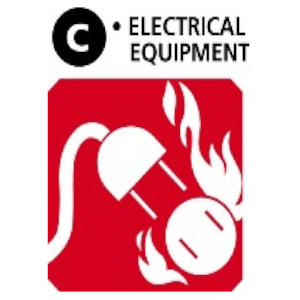
What type of materials would be burning for a fire to be classified as a Class C fire?
Wiring
Fuse boxes
Energized electrical equipment ELECTRICAL EQUIPMENT
Computers
Other electrical sources
* For fires involving electrical equipment, Carbon Dioxide (CO2) and Dry Chemical extinguishers are used. See FAQ under Type B fires. CO2 and dry chemical extinguishers are both used for electrical equipment fires.
Would there be any reason to use a CO2 over a dry chemical extinguisher for an electrical fire?
BC and ABC fire extinguishers both leave a residue after the fire has been put out. If the fire has started on delicate electrical equipment such as a computer or TV, it might be wise to consider a CO2 extinguisher because it does not leave a residue. A dry chemical one will leave a residue that can damage the equipment.
Fire Extinguishers For Class A, B & C Fires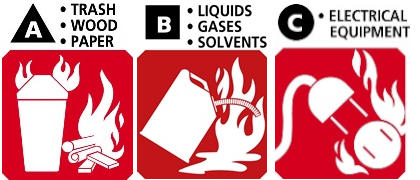
Are there any multipurpose fire extinguishers that are labeled A, B and C altogether?
Yes, there is the ABC Fire Extinguisher. This type will be labeled and rated for B and C fires and may be marked multipurpose for use on A, B and C fires.
What does this type look like?
They are red in color and range in size from five pounds to twenty pounds.
What are the components of this type of extinguisher?
They use dry chemical fire retardant powder made up of monoammonium phosphate. It is a yellow powder that will leave a sticky residue once the fire has been extinguished.
How is the fire extinguished with this type?
It is a dry chemical extinguisher that puts out fires by coating the fuel with a thin layer of a fire retardant powder. It will separate the fuel from the oxygen. The powder will also interrupt the chemical reaction of the fire.
Does this type require any special maintenance?
The powder in dry chemical extinguishers can “pack” inside the unit over time so lightly rock this type every few months to ensure that this does not happen.
Are these the most popular units sold being that they can put out almost any kind of fire?
Yes, 5 and 10 pound ABC fire extinguishers represent over 80% of all types sold. They meet most codes for standard requirements. It is important to note that code requirements are only minimum guidelines.
Other Special Type of Fires and Fire Extinguishers:
Fire Extinguishers For Class D Fires
What type of materials would be burning for a fire to be classified as a Class D fire?
Powders, flakes or shavings of combustible METALS (such as magnesium, titanium, potassium and sodium).
What are the components of a Class D fire extinguisher?
The ones that are labeled for a type D fire can contain a sodium chloride based dry powder extinguishing agent, but most of the ones that are labeled Class D have components that are geared to a specific metal.
Is there a picture on the side of this type of extinguisher?
There are no pictures for this type.
Are there any recommendations for the placement of these extinguishers?
OSHA recommends that they are not more than 75 feet from the hazard.
Fire Extinguishers For Class K Fires
What type of materials would be burning for a fire to be classified as a Class K fire?
Oils
Fats COMBUSTIBLE COOKING FLUIDS
When would you need to use a fire extinguisher labeled for a Class K fire?
They are now required to be installed in all applicable restaurant kitchens because of the higher heating rates of vegetable oils used in commercial cooking. Grease fires commonly occur in Commercial Kitchens. If a fire starts in a deep fryer, it is not always possible to extinguish it with a Class B extinguisher or traditional range hood installed in the kitchen.
How would you know when to use this special type?
This type is only to be used AFTER the activation of a built-in hood suppression system. If there is no built in hood suppression system, then there is no requirement to use a Class K fire extinguisher.
What are the components of this type of extinguisher?
There are different agents that are used in the ones that are labeled Class K. Some of these agents are dry and some are wet. Potassium bicarbonate is used in some of the dry chemical ones and some wet ones spray a fine chemical mist.
Are there any special precautions that need to be taken with this type?
The extinguishing agents in the ones labeled for type K fires are sometimes electrically conductive and should only be used AFTER the power has been turned off in the electrical appliance. The job of the class K Fire Extinguisher is to put the fire out and prevent re-flash.
Are there any recommendations for the placement of these units?
They must be placed at a maximum travel distance of thirty feet.
The information on this page is an original copyrighted article. We welcome you to link this page from your website. However, copying this article in whole or in part is strictly prohibited.
Disclaimer: We have provided this article as general information on the use of this article. We make no claims as to the accuracy or completeness of the information as it may apply to an infinite amount of conditions and situations. It is the responsibility of the person or persons reading and using this information to refer to the instructions and information provided by the manufacturer in the product package before testing or using this product. Users of this information agree to hold Select Safety Sales LLC harmless from liability of any kind relating to the use of this information.
